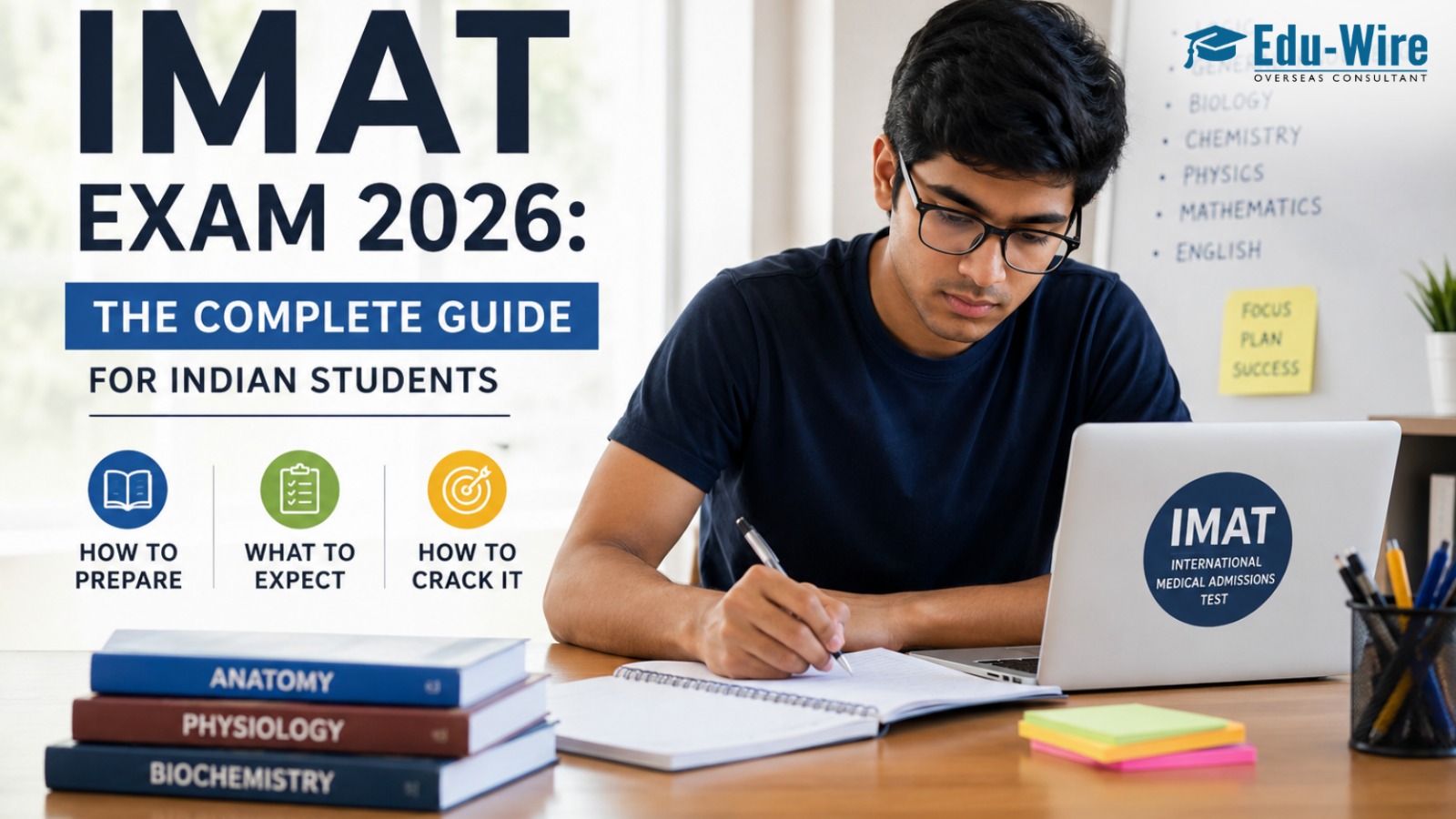
What Is IMAT?
IMAT stands for International Medical Admissions Test. It is the entrance exam for international students who want to study Medicine and Surgery (MBBS equivalent) at Italian state universities — entirely in English. Conducted by Cambridge Assessment Admissions Testing on behalf of the Italian Ministry of University and Research (MUR), IMAT is the single most important factor in determining whether you get a seat at Italy's top medical universities. There is no shortcut. No donation seat. No management quota. One exam. One ranking. The top scorers get the seats.
Top Italian Universities Accepting IMAT Scores
- Università di Bologna
- Università La Sapienza, Rome
- Università degli Studi di Milano
- Università di Pavia
- Università di Napoli Federico II
- Politecnico di Torino (Medicine)
IMAT Exam Structure
IMAT is a 100-question, 100-minute multiple choice exam. Every question has 5 answer choices and only one is correct. 93 questions are scored; 7 are unscored trial items.
| Section | Questions | Topics Covered |
|---|---|---|
| Section 1: Logical Reasoning & General Knowledge | 23 | Critical thinking, problem-solving, general awareness |
| Section 2: Biology | 23 | Cell biology, genetics, anatomy, physiology, evolution |
| Section 3: Chemistry | 15 | Organic chemistry, stoichiometry, periodic table, reactions |
| Section 4: Physics | 12 | Kinematics, dynamics, energy, thermodynamics, optics |
| Section 4: Mathematics | 10 | Algebra, calculus basics, probability, geometry |
| TOTAL (Scored) | 93 | 7 additional unscored trial questions |
IMAT Scoring System
| Answer Type | Marks |
|---|---|
| Correct Answer | +1.5 |
| Wrong Answer | −0.4 |
| Unanswered / Skipped | 0 |
| Starting Score (given to all) | +1.5 |
| Maximum Possible Score | 90 |
Historical Cutoff Scores (Approximate — Top Universities)
| Year | Approximate Cutoff |
|---|---|
| 2019 | 40–45 |
| 2020 | 35–40 |
| 2021 | 45–50 |
| 2022 | 42–48 |
| 2023 | 43–49 |
| 2024 | 44–50 |
Section-by-Section Preparation Strategy
Section 1: Logical Reasoning & General Knowledge (23 Questions)
This section is unique to IMAT — not covered in standard school syllabi — and most Indian students underestimate it badly. It tests critical thinking, problem-solving, pattern recognition, and general awareness. Questions test application, not recall.
- Practice past IMAT papers — volume is the only substitute
- Work through Cambridge A-Level Thinking Skills papers
- Read quality science journalism (Scientific American, New Scientist)
- Target 30 minutes for this section during practice
- Do NOT memorise facts for general knowledge — questions test application
- Do NOT skip this section in your prep plan — it is 25% of the paper
- Do NOT spend more than 2–3 minutes on any single question
Section 2: Biology (23 Questions)
Biology is the highest-weighted science section and the area where most marks are won or lost. IMAT tests why things happen — mechanisms, not just definitions.
- Cell Biology: organelles, membrane transport, mitosis, meiosis, cell cycle, apoptosis
- Genetics: Mendelian genetics, DNA replication, transcription, translation, mutations
- Human Physiology: digestive, circulatory, respiratory, excretory, nervous, endocrine, immune, and reproductive systems
- Evolution & Ecology: natural selection, speciation, ecological relationships, population dynamics
- Use Campbell Biology as your primary reference
- Solve at least 200 past IMAT biology questions before exam day
Section 3: Chemistry (15 Questions)
IMAT Chemistry leans heavily toward organic chemistry and stoichiometry — two areas requiring both conceptual understanding and calculation speed.
- Physical Chemistry: atomic structure, periodic trends, chemical bonding, thermodynamics, electrochemistry
- Inorganic Chemistry: acids and bases, oxidation-reduction, equilibrium, solubility
- Organic Chemistry: functional groups, nomenclature, reaction mechanisms, isomerism, polymers, biomolecules
- Stoichiometry: mole concept, balancing equations, limiting reagents, concentration calculations
- Learn organic chemistry mechanisms, not individual reactions — use Solomon's Organic Chemistry
- Master stoichiometry calculations early — they appear across multiple question types
Section 4: Physics & Mathematics (22 Questions)
- Physics: kinematics, dynamics, energy and work, fluid mechanics, thermodynamics, electrostatics, circuits, waves and optics
- Mathematics: algebra, trigonometry, logarithms, sequences, basic calculus, probability, statistics, geometry
- Physics in IMAT is conceptual — formula application, not derivation
- Mathematics questions are often the quickest marks to earn if fundamentals are strong
- Review the Italian high school Physics and Maths syllabus — it aligns directly with IMAT scope
- Target 20 minutes for the combined Physics + Maths section
IMAT 2026 — Key Dates & Registration
| Milestone | Approximate Date |
|---|---|
| Registration Opens | June 2026 |
| Registration Deadline | Late July 2026 |
| IMAT Exam Date | September 2026 |
| Results Released | October 2026 |
| University Enrollment Deadline | November 2026 |
6-Month IMAT Preparation Plan
Common Mistakes IMAT Candidates Make
- Starting Too Late: Most successful IMAT candidates begin preparation 8–12 months before the exam. Starting 3 months before is not enough.
- Ignoring Logical Reasoning: It is 23 questions — 25% of the paper. Most Indian students lose the exam in Section 1.
- Not Practising Under Timed Conditions: Knowing the content is not the same as answering questions in 60 seconds under pressure.
- Guessing Randomly: With −0.4 negative marking, random guessing destroys scores. Strategic skipping and educated elimination are skills.
- Using Only School Textbooks: NCERT covers approximately 60% of the IMAT syllabus. Organic Chemistry, advanced Biology, and Logical Reasoning require additional resources.
- Not Analysing Mock Tests: Writing a mock test and not reviewing every wrong answer is wasted practice. The review is where the actual learning happens.
Is IMAT Right for You?
- You want to become a doctor and are serious about the commitment
- You want a globally recognised medical degree
- You want to study in English in Europe
- You are willing to prepare rigorously for 6–12 months
- You want merit-based admission without capitation fees
- You are looking for an easy route into medicine
- You are unwilling to invest sustained preparation across multiple subjects
- You need admission without sitting a competitive exam
How Edu-Wire Helps You Crack IMAT
Frequently Asked Questions
IMAT is not about finding a shortcut into medicine. It is about earning your seat on merit — and for students who prepare seriously, it is one of the best opportunities in the world to become a doctor.
— Edu-Wire IMAT Guidance Team

.gif)